You’ve cleared a patch of floor. You have twenty minutes. You’re not sure what to do with either.
That’s enough to start.
Strength training doesn’t need a gym, a complicated plan or heavy weights on day one. A few movements, done twice a week, are enough to begin. This guide covers what counts, how often to train, what a session looks like and when to check in with a health care provider.
It’s for anyone starting from zero or coming back after a long break, men and women alike. Some questions are specific to women or to starting later in life. Those have their own guides: Strength Training for Women and Starting Strength Training at 50+.
What strength training is (and what counts)
Strength training, also called resistance training, means making your muscles work or hold against a force or weight. That force can come from dumbbells or a barbell. It can come from an elastic band. It can come from your own body weight.
The CDC’s examples include push-ups, lifting weights, working with resistance bands and heavy gardening. So the bar for “counts” is lower than most people think.
A gym is one option, not a requirement. In 2026, the American College of Sports Medicine (ACSM) published a position stand that reviewed the research on resistance training in healthy adults. It found that elastic bands and home-based training improve strength. It also found no consistent difference in strength gains between machines and free weights.
Use what you can get to. Training without a gym is covered properly in Strength Training at Home.
Why it’s worth starting
Stronger muscles make ordinary jobs easier. Stairs. Shopping bags. Getting up off the floor. Resistance training improves strength and physical function in healthy adults.
US physical activity guidelines recommend muscle-strengthening activity for adults and note that these activities provide additional health benefits. More broadly, regular physical activity is linked with better bone health, physical function and quality of life.
There’s also observational research. In long-term studies, people who did muscle-strengthening activity tended to have lower rates of several major diseases, including cardiovascular disease and type 2 diabetes. That’s an association, not proof that lifting caused it. And more wasn’t automatically better in those studies.
The most useful finding for a beginner is the simplest. According to the ACSM, the biggest jump in results comes from going from no resistance training to any.
You don’t need the perfect plan. You need to start.
How often to train
Start with two days a week.
US guidelines recommend muscle-strengthening activities that work all the major muscle groups on at least 2 days a week. The CDC lists those groups as the legs, hips, back, abdomen, chest, shoulders and arms. The ACSM’s 2026 position stand lands in the same place: at least twice a week, all major muscle groups.
The simplest way to hit every group twice is two full-body sessions. That’s a practical choice, not the only way to do it.
Start lighter than you think you need to. The US guidelines have a phrase for it: “start low and go slow.” Build up from there.
Spacing your sessions
Many people find it easier to leave a day or two between sessions. Monday and Thursday, say. Treat that as a scheduling habit, not a rule.
Recovery outside your sessions, sleep included, has its own guide: Sleep Hygiene.
What a beginner session includes
Pick a few movements that cover your whole body
Most strength exercises are versions of five basic movements. Pick one exercise for each and most of your body is covered.
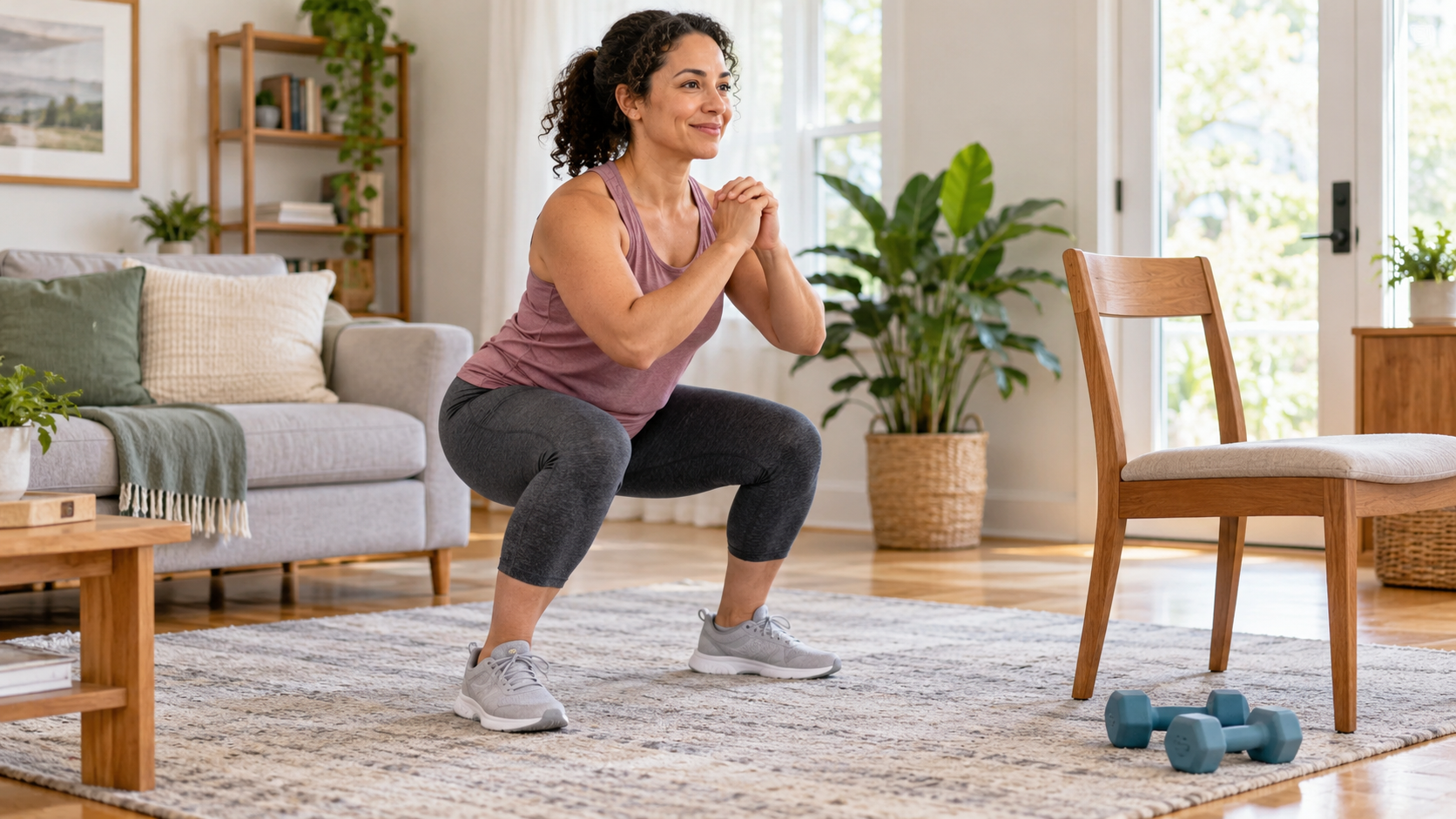
- Squat: bend at the knees and hips, then stand. Sitting down to a chair and standing back up is a squat.
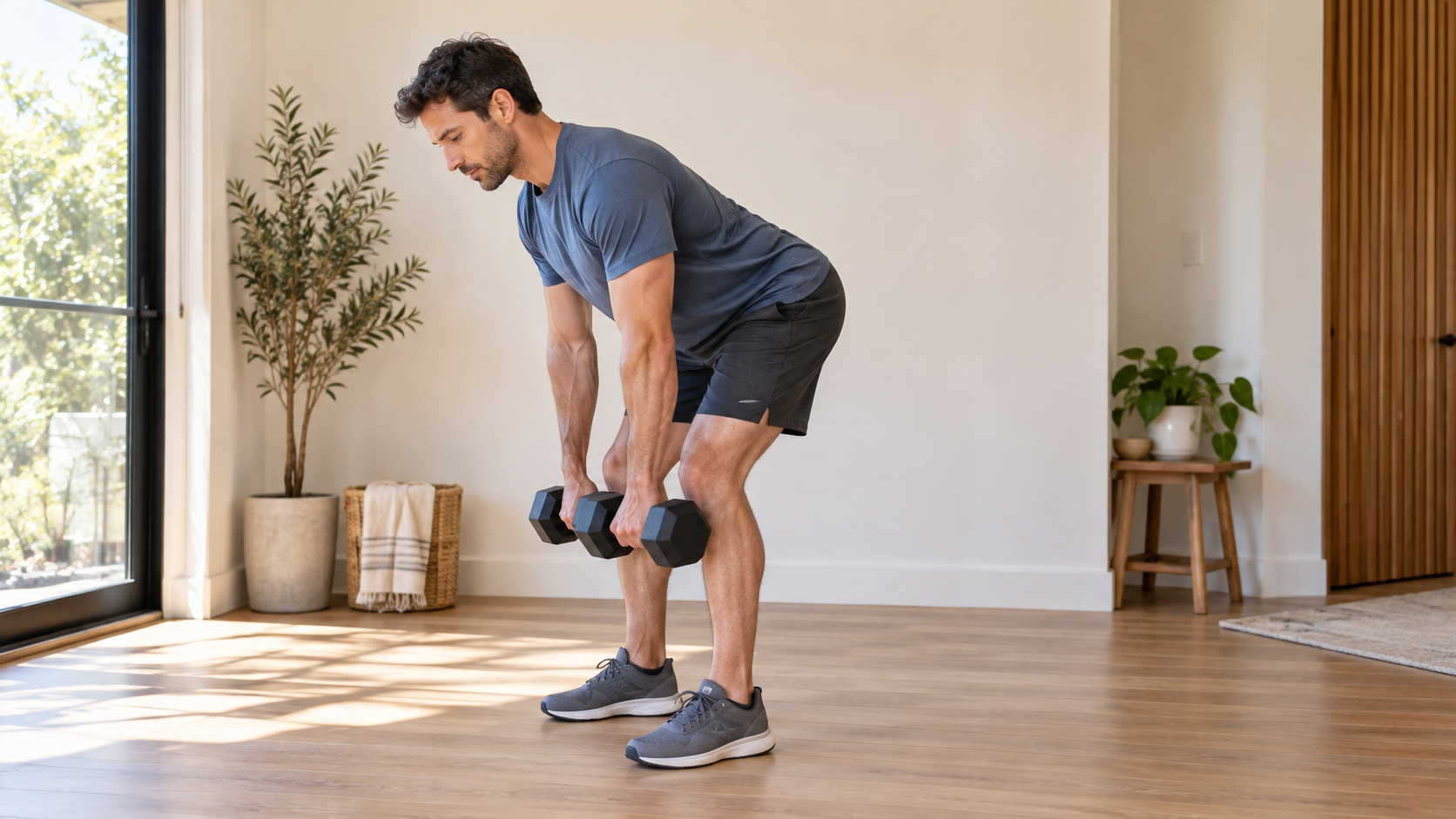
- Hinge: fold forward at the hips with a long back. A dumbbell deadlift is the classic example.
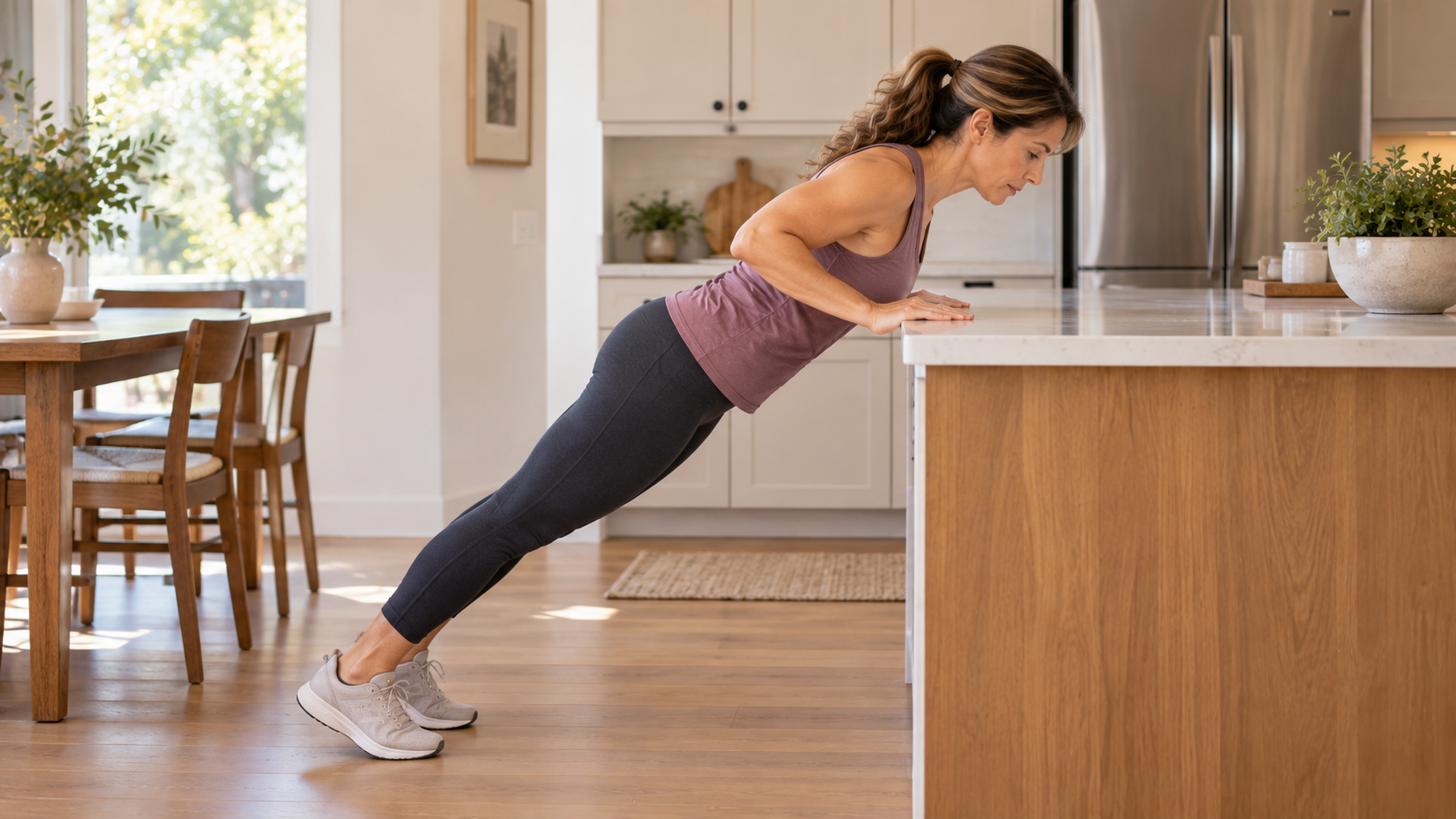
- Push: press something away from you. A push-up against a wall is the easiest version.
- Pull: draw something toward you. A resistance-band row works well at home.
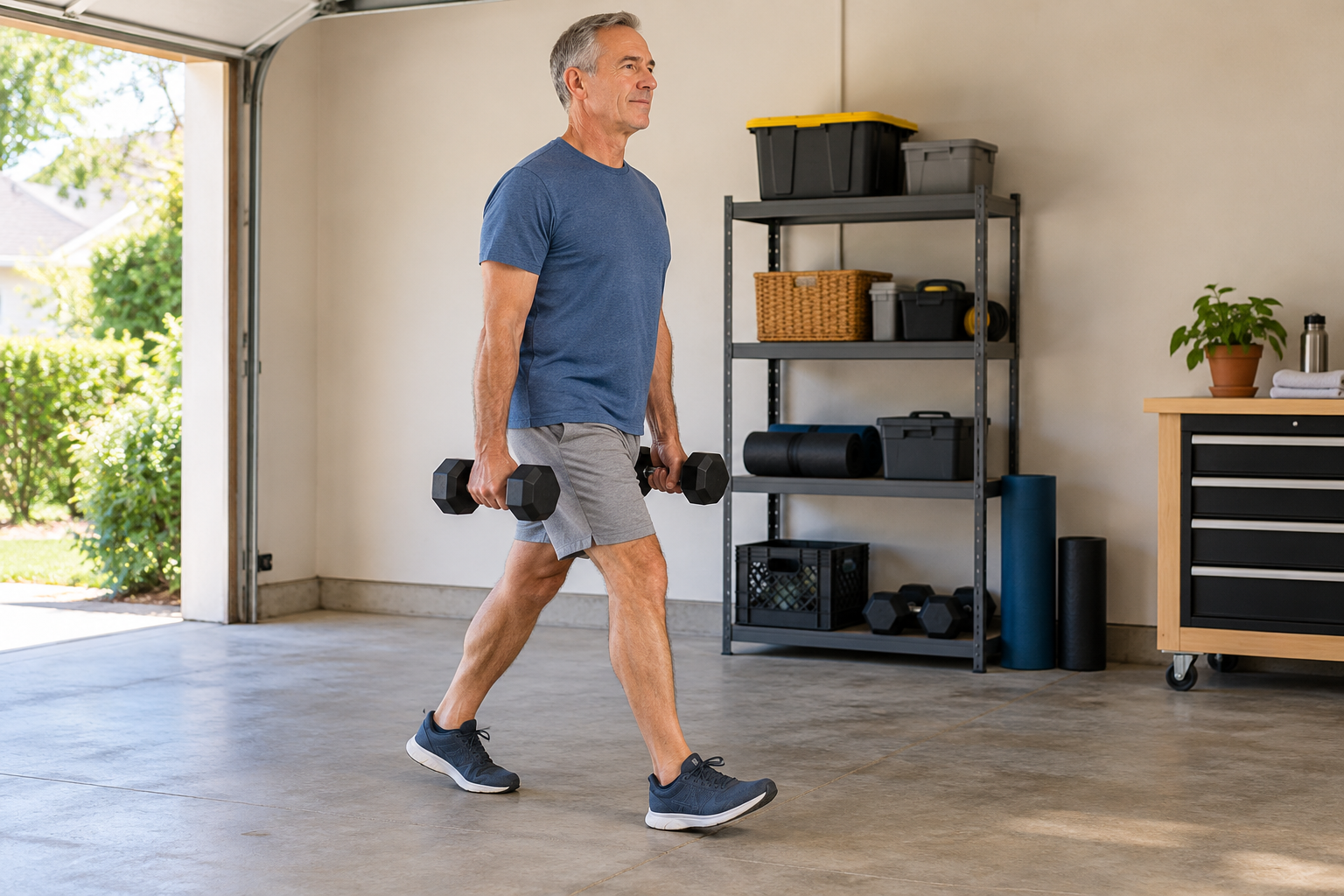
- Carry: pick up something heavy and walk tall.
Don’t worry about perfecting all five on day one. How to do each one, step by step, is in Strength Training Exercises for Beginners.
Sets, reps and how hard it should feel
A repetition, or rep, is one complete movement. One squat. One push-up. A set is a group of reps done back to back.
US guidance describes one set as 8 to 12 repetitions. It says one set of each exercise is effective, though two or three sets may be more effective. The ACSM’s newer guidance advises at least two sets per exercise, and found that two sets beat one.
So one set already counts. Two is a sensible target once the movements feel familiar.
Now effort. The last few reps of a set should feel hard. The CDC’s wording is to work until it’s hard to do another repetition without help.
You don’t have to go all the way to failure, though. Failure means the point where you can’t complete another rep. The ACSM’s review found that training to failure didn’t improve gains in strength, muscle size or power. One suggested target is to stop with two or three reps left in reserve. The review mentions that target, but says the evidence can’t yet pin down an exact number.
Rest between sets long enough to do the next one with good form.
Rep ranges for different goals, rest periods and the rest of the detail are in Sets, Reps and Rest.
Warm up briefly
Start with a few minutes of easy movement. A brisk walk around the block works. So does a light first set of your first exercise.
US guidelines treat a warm-up as an acceptable part of an activity plan. My bet is the light first set teaches you more than anything else you could do in those minutes. You feel the movement before it gets hard.
Your first week: a simple example
Here’s one way to put the pieces together. It’s an example, not the one correct plan.
Two sessions this week. Monday and Thursday, or whatever two days fit your schedule.
Each session: warm up for a few minutes, then do one exercise from each of the five movements. Aim for two sets of 8 to 12 reps. For the carry, walk a short distance twice. By the last reps of each set, the movement should feel hard but controlled.
Choose the easier or harder version of each:
| Movement | Easier | Harder |
|---|---|---|
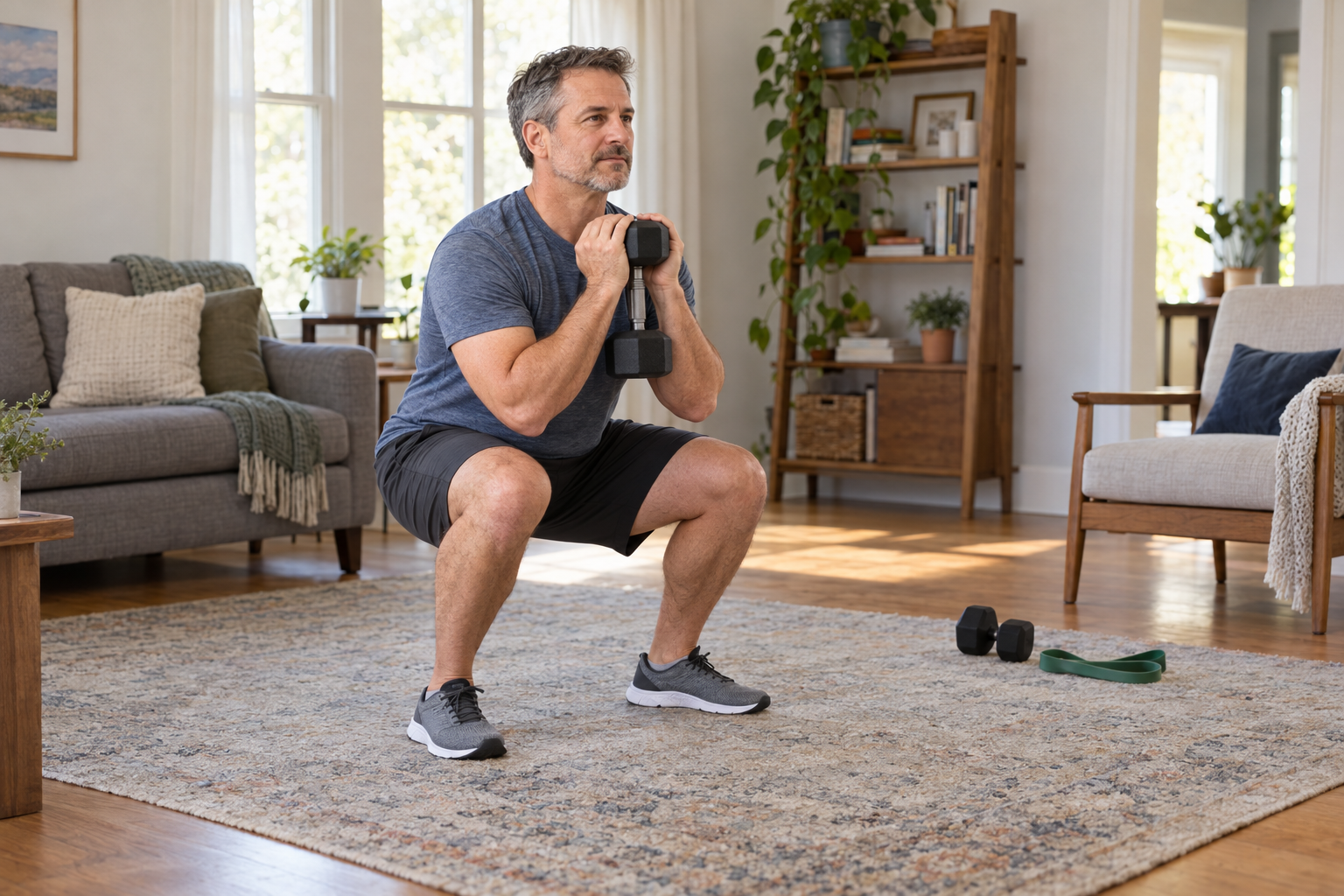
| Squat | Sit down to a chair and stand up | Hold a dumbbell at your chest as you squat |
| Hinge | Dumbbell deadlift with a light weight | Dumbbell deadlift with a heavier weight |
| Push | Push-up against a wall | Push-up with hands on a sturdy bench, or on the floor |
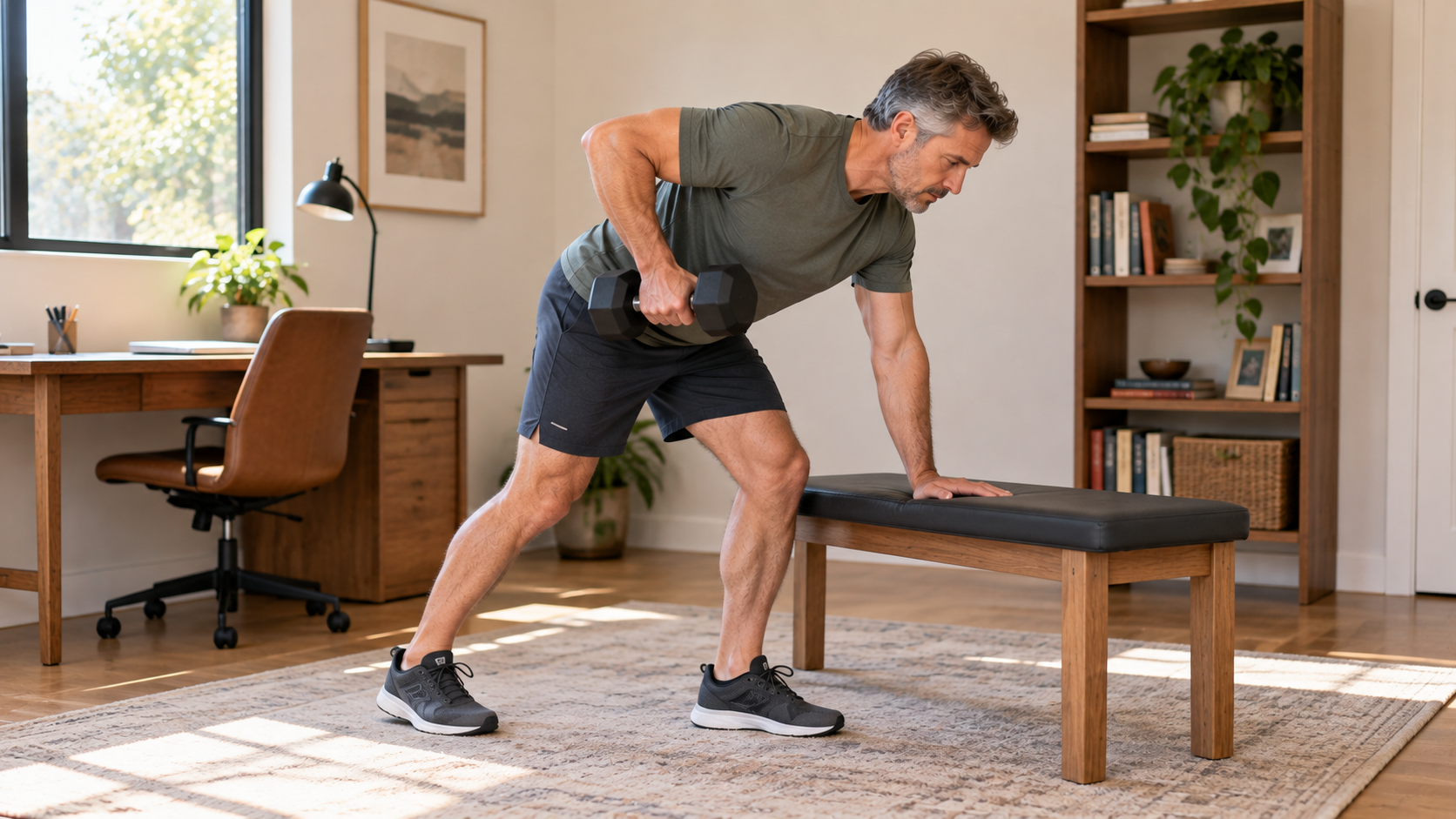
| Pull | Resistance-band row | One-arm dumbbell row |
| Carry | A full shopping bag in each hand | A heavier dumbbell in each hand |
In a gym, machines such as a leg press, chest press and seated row can stand in for the squat, push and pull. At home, body weight, a band and a pair of dumbbells cover the whole table. The full home setup is in Strength Training at Home.
One thing this guide leaves out on purpose: food and supplements. Supplements such as creatine have their own explainer: Creatine.
Getting stronger over time
Here’s how progress actually works, according to the research.
You don’t need a progression plan to start getting benefits. The ACSM’s 2026 review says plainly that progression is not necessary to achieve beneficial outcomes.
There’s a catch for beginners, though. Many start with very light loads, and sensibly so. The same review notes that when inexperience means loads have to start low, progression becomes a requirement for a meaningful benefit. And to keep improving over months and years, you’ll likely need to make your sessions gradually harder. US guidance says the same thing in plain terms: more weight, or more days a week, builds stronger muscles.
Harder can mean a little more weight, a couple more reps or an extra set.
Keep a simple log. Write down the exercise, the weight and the reps. It takes a minute, and it tells you when you’re ready for more.
How and when to step things up is covered in Progressive Overload.
Staying safe as a beginner
For most people, the news is reassuring. Everything in this section comes from the US physical activity guidelines. Those cover physical activity in general, not strength training specifically.
If you’re generally healthy and building up gradually, the guidelines say that, in general, you don’t need to consult a health care provider before becoming more active. More precisely, they say people without diagnosed chronic conditions (such as diabetes, heart disease or osteoarthritis) and without symptoms (such as chest pain or pressure, dizziness or joint pain) most likely don’t need to.
The ACSM describes resistance training as safe for healthy adults of all ages. Its review covered healthy adults only.
If you have a known chronic condition or symptoms, the guidelines recommend being under the regular care of a health care provider. With a health care professional or a physical activity specialist, you can work out a plan that suits you.
If new symptoms appear as you increase your activity, the guidelines say to consult a health care provider.
Pregnancy and the postpartum period, and chronic conditions or disabilities, have their own sections in the US guidelines.
Want someone to check your form? A qualified trainer or coach can help. It’s useful, but not required.
Common beginner questions
Should I do cardio as well?
Yes. US guidelines recommend that adults do both aerobic activity and muscle-strengthening activity.
Do I need to lift until I can’t do another rep?
No. Work hard enough that the last reps are a real effort, then stop. Going to complete failure didn’t improve results in the ACSM’s review.
Is it too late to start at 50 or 60?
No. The ACSM describes resistance training as safe for healthy adults of all ages, and the biggest gain comes from starting at all. What changes with age, and how to adjust, is in Starting Strength Training at 50+.
If new symptoms show up as you get more active, talk to a health care provider.
Then pick two days this week. Put them in your calendar. Choose one exercise for each movement, easier or harder. Do two sets of each and write down what you did.
Next week, look at your notes. Do the same again.
Sources
- U.S. Department of Health and Human Services. Physical Activity Guidelines for Americans, 2nd edition. 2018.
- Centers for Disease Control and Prevention. Adult Activity: An Overview. 2023.
- Centers for Disease Control and Prevention. What Counts as Physical Activity for Adults. 2023.
- Office of Disease Prevention and Health Promotion (HHS). Top 10 Things to Know About the Second Edition of the Physical Activity Guidelines for Americans. last updated 2025.
- Currier BS, D'Souza AC, Fiatarone Singh MA, Lowisz CV, Rawson ES, Schoenfeld BJ, Smith-Ryan AE, Steen JP, Thomas GA, Triplett NT, Washington TA, Werner TJ, Phillips SM. Medicine & Science in Sports & Exercise 58(4):851–872. American College of Sports Medicine Position Stand. Resistance Training Prescription for Muscle Function, Hypertrophy, and Physical Performance in Healthy Adults: An Overview of Reviews. 2026.
- American College of Sports Medicine. 5 Things to Know About Creating an Effective Resistance Training Plan (2026 position stand summary). 2026.
- Momma H, Kawakami R, Honda T, Sawada SS. British Journal of Sports Medicine 56(13):755–763. Muscle-strengthening activities are associated with lower risk and mortality in major non-communicable diseases: a systematic review and meta-analysis of cohort studies. 2022.
This article is for general information and isn’t a substitute for personal medical advice. If you have health concerns, speak to a qualified professional.