Stand up from your chair. Now sit back down, slowly.
That’s a squat pattern. You’ve been doing it all your life.
This guide takes five everyday movements and gives you one exercise for each, with a version you can start with. New to strength training altogether? Get the bigger picture in Strength Training for Beginners first.
The five movement patterns, and why they’re a useful shortcut
One common way coaches organize a beginner routine is by movement pattern. The five used here are:
- Squat: bending at your hips and knees to lower down and stand back up.
- Hinge: bending forward from your hips with a long, flat back, like reaching down to pick something up.
- Push: pushing a weight, or your own body, away from you.
- Pull: pulling a weight toward you.
- Carry: walking while holding something heavy.
The National Academy of Sports Medicine uses this list. Other organizations sort exercises differently. The American Council on Exercise, for example, uses squatting, lunging, pushing, pulling and rotating. Treat the five as a handy checklist, not a rule.
US guidelines ask for muscle-strengthening work that covers the major muscle groups: legs, hips, back, chest, abdomen, shoulders and arms. One exercise from each pattern is a simple way to get there.
The exercises below are our choice; other good options exist. A 2026 review of reviews from the American College of Sports Medicine found that many kinds of resistance training work, and that getting some done matters more than finding the perfect exercise.
| Pattern | Main exercise | Easier or alternative option | Harder version |
|---|---|---|---|
| Squat | Bodyweight squat | Chair rise | Goblet squat |
| Hinge | Dumbbell Romanian deadlift (light dumbbells) | Hip hinge with no weight | Heavier dumbbells |
| Push | Incline push-up, hands on a sturdy bench | Wall push-up | Push-up on the floor |
| Pull | One-arm dumbbell row, supported on a bench or chair | Seated band row (no-dumbbell option) | Heavier dumbbell |
| Carry | Farmer’s carry | Lighter weights or a shorter walk | Heavier weights |
Before you start: how to move well
- Breathe. Don’t hold your breath. Breathe out during the hard part, and breathe in as you relax.
- Warm up. Run through each movement first with no weight or a lighter one.
- Straighten without snapping. Don’t snap your arms or legs into a hard lock at the top of a movement.
- Use the range you control. Move as far as your form holds, and no further. The 2026 ACSM review found that training through a full range of motion built more strength than partial movements.
- Brace. Tighten your stomach muscles so your middle feels firm and your back stays steady.
Want someone to check your form? A session or two with a personal trainer, a group class or free online demonstration videos can all help.
Squat: bodyweight squat
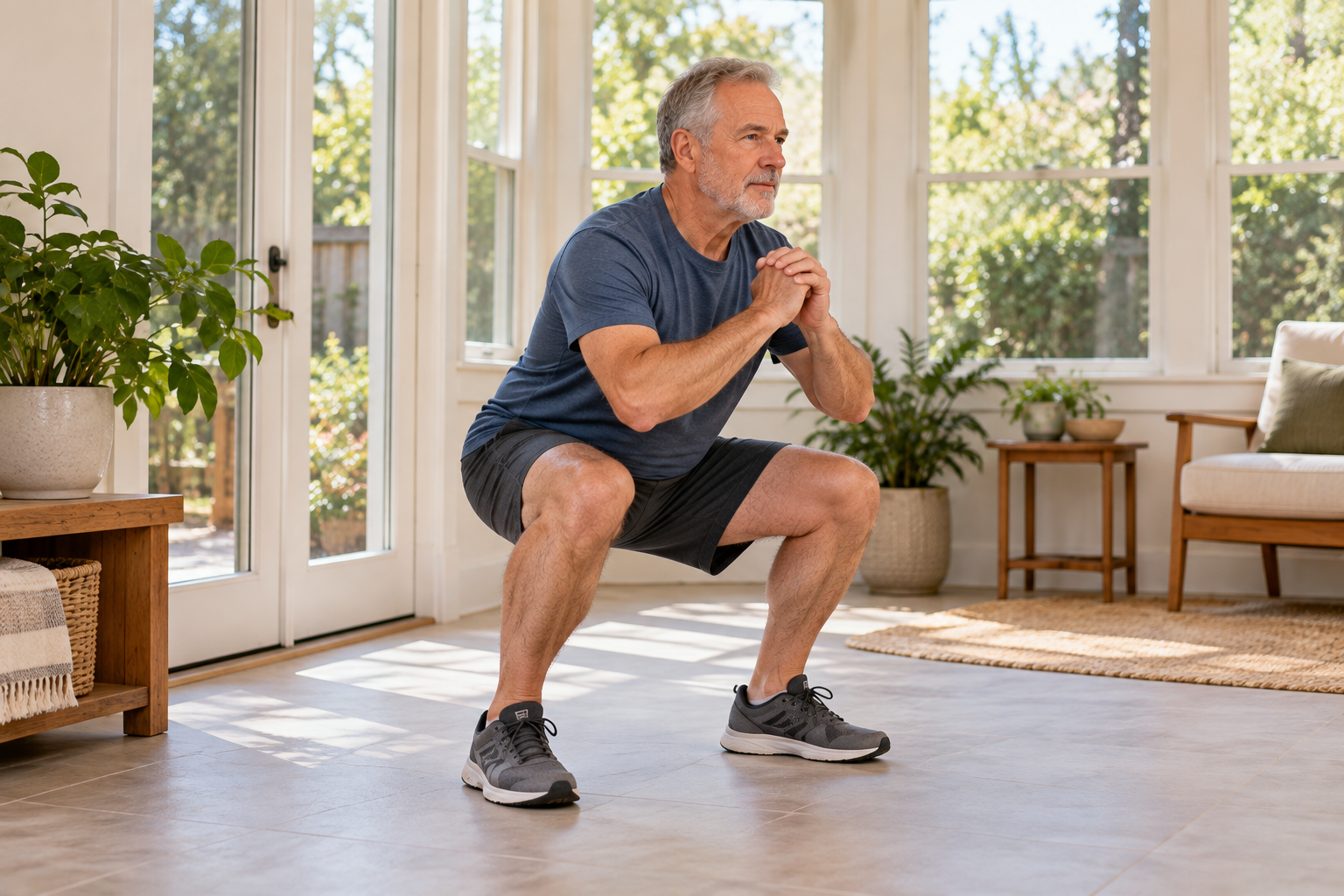
How to do it
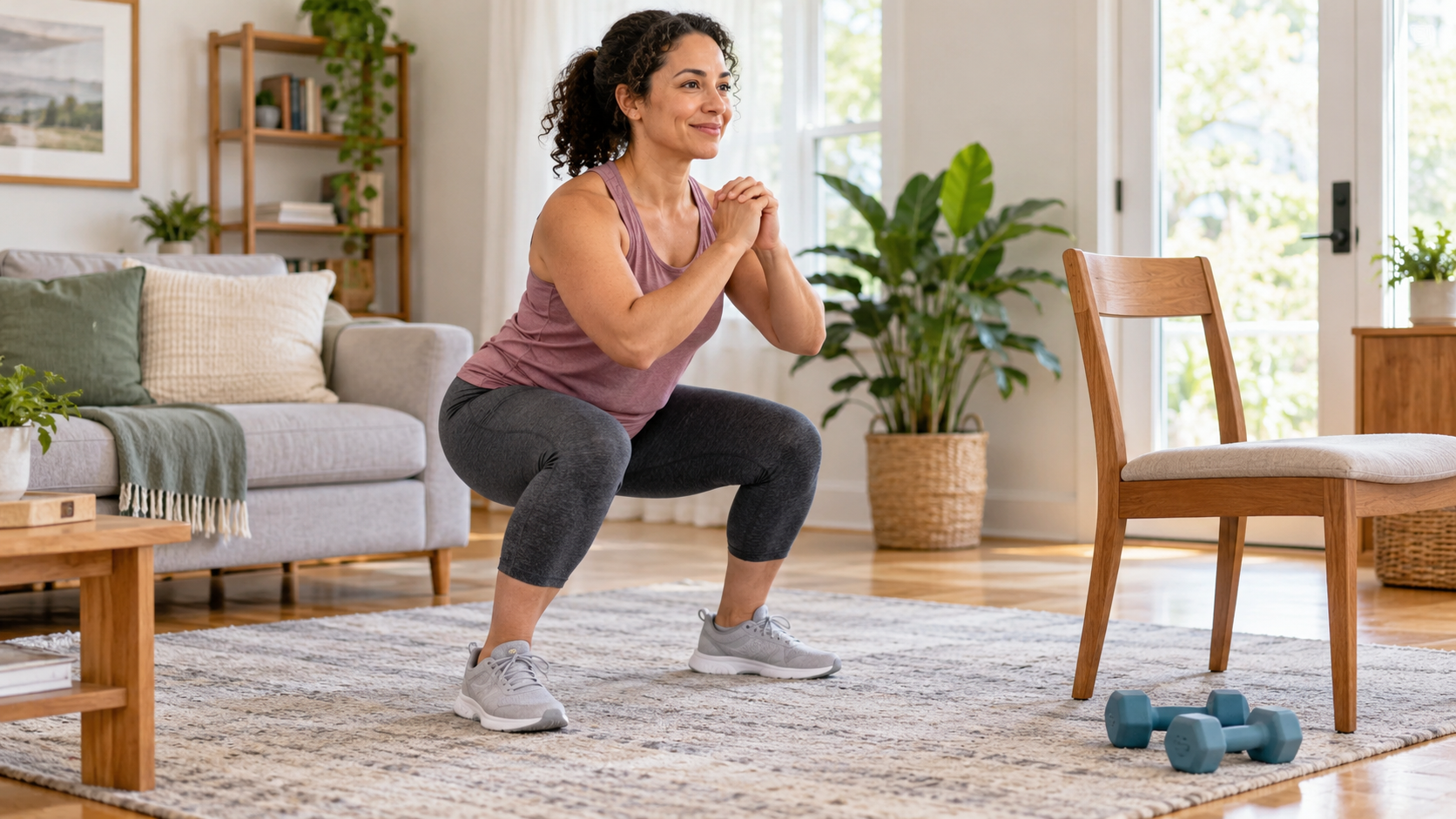
- Stand with your feet slightly wider than hip-width, toes turned out a little.
- Brace your middle and lift your chest.
- Start the movement by pushing your hips back, then bend your knees and lower down. Keep your back flat.
- Keep your knees in line with your second toe as they bend.
- Go down until your thighs are about parallel to the floor, or stop earlier if your heels start to lift or your back starts to round.
- Push through your heels to stand back up. Breathe in on the way down and out on the way up.
Watch for: heels lifting or your back rounding at the bottom. Either one means you’ve gone as low as you can control for now.
You should feel: your thighs and hips working.
Make it easier: chair rise
- Sit toward the front of a sturdy chair, knees bent, feet flat on the floor and shoulder-width apart.
- Rest your hands lightly on the seat beside you. Keep your back straight.
- Lean forward so your weight moves onto the front of your feet.
- Breathe out and stand up slowly, using your hands as little as you can.
- Breathe in and sit back down slowly. Don’t drop into the chair; control the way down.
The chair rise works the muscles in your thighs and buttocks.
Harder version: goblet squat. Hold one dumbbell upright in front of your chest, elbows close to your ribs, and squat the same way, only as low as you can control.
Hinge: dumbbell Romanian deadlift
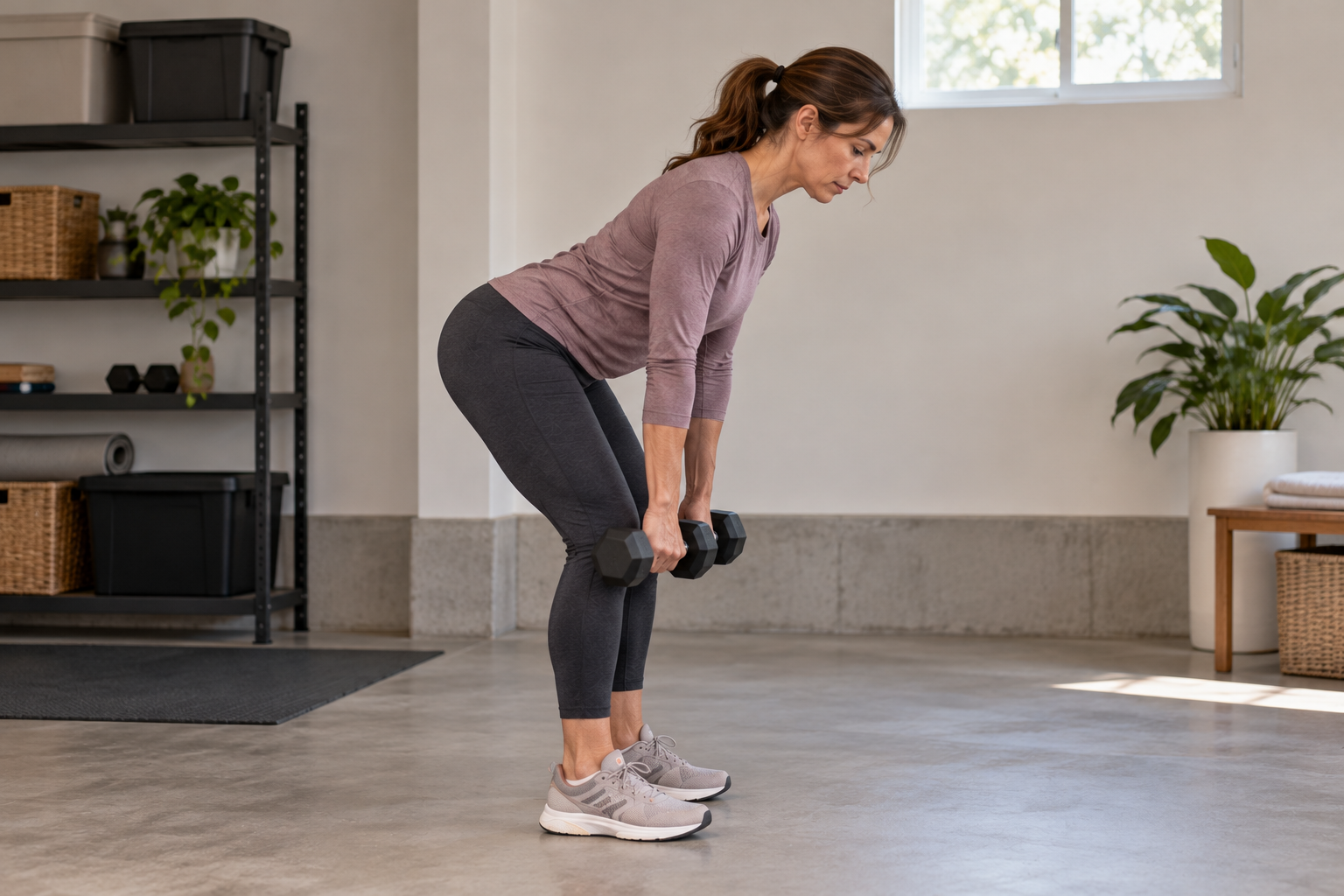
The Romanian deadlift is a version of the deadlift, and it’s the one this guide teaches, with a dumbbell in each hand instead of a barbell.
Learn the hinge first, with no weight
Practice the movement before you hold anything.
- Stand with your feet hip-width apart and a slight bend in your knees.
- Push your hips back, as if your tailbone is moving toward the wall behind you.
- Let your chest tip forward while your back stays long. Keep the slight bend in your knees; don’t let them bend further.
- Lower until you feel tension in the back of your thighs.
- Press your hips forward to stand tall again.
The American Council on Exercise suggests adding weight once you can do 10 to 15 good hinges in a row with your back staying steady. Treat that as a practical guide, not a test.
Add light dumbbells
- Hold a light dumbbell in each hand in front of your thighs.
- Lift your chest and draw your shoulder blades down.
- Hinge exactly as you practiced. Let the dumbbells slide down close to your thighs as you lower.
- Stop when you feel tension in the back of your thighs. Press your hips forward to stand.
Watch for: your back rounding as you lower, or your knees bending more and more until the hinge turns into a squat.
You should feel: tension in the back of your thighs.
Heavier dumbbells come later. When and how to step up is covered in Progressive Overload.
Push: incline push-up
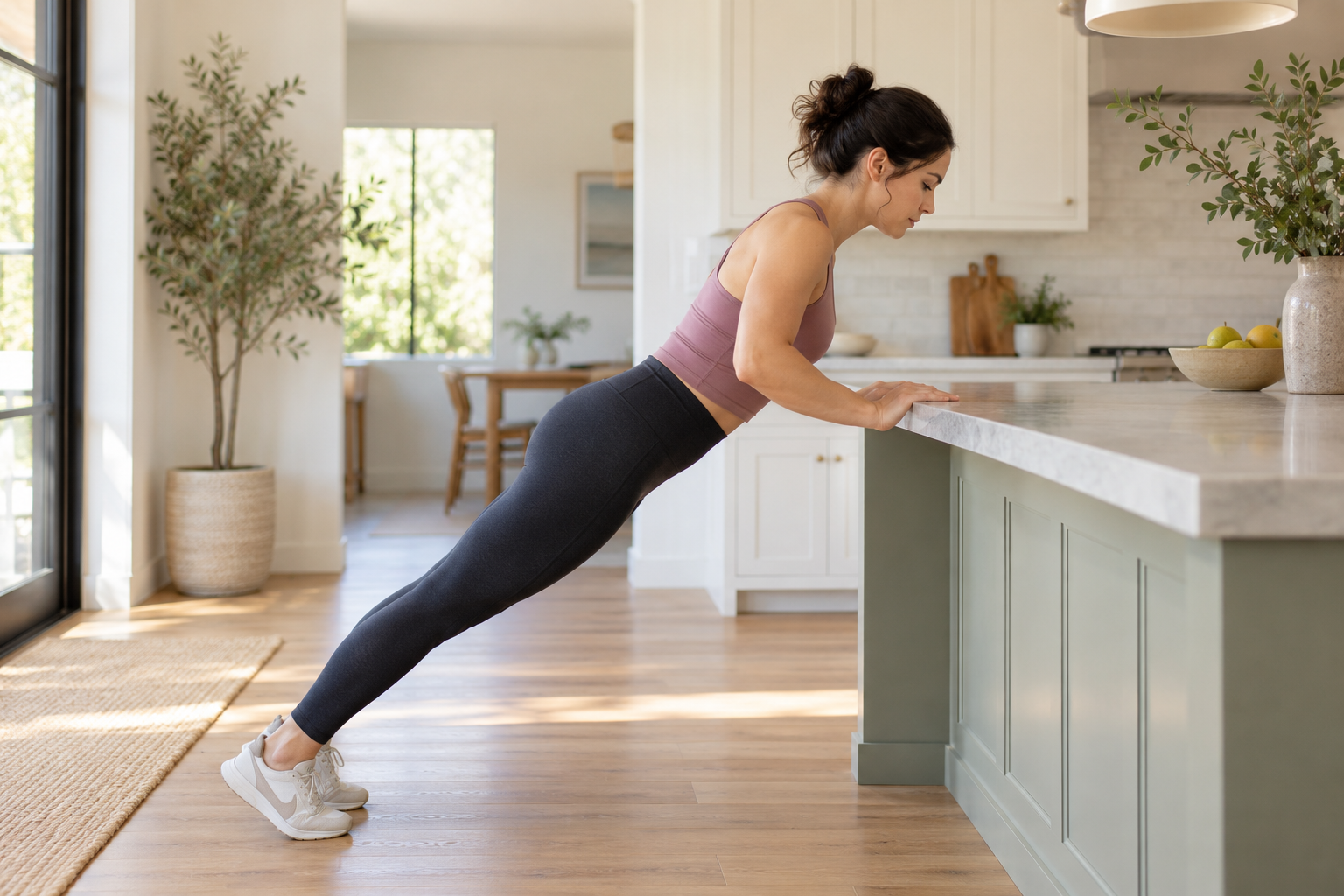
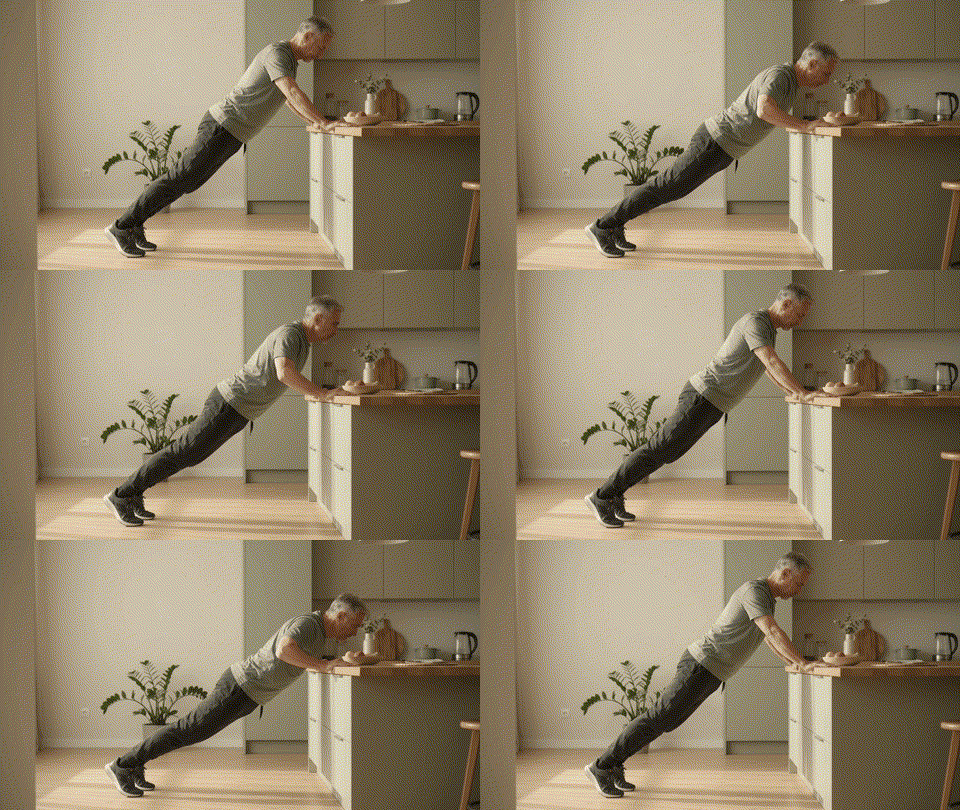
With your hands on something raised, a push-up is easier than on the floor, and you still practice the same movement.
How to do it
- Place your hands on a sturdy bench, slightly wider than shoulder-width apart.
- Walk your feet back until your body makes a straight line from your head to your heels. Brace your middle.
- Bend your elbows to lower your chest toward the bench, keeping your body stiff like a plank.
- Push the bench away to come back up.
Watch for: your lower back sagging, or your hips poking up. Your body should move as one piece.
You should feel: your chest, shoulders and arms doing the work.
Make it easier: wall push-up
If the bench version is too hard to do with control, use a wall.
- Stand facing a wall, about an arm’s length away.
- Put your palms flat on the wall, shoulder-width apart and at shoulder height.
- Keep your body in a straight line from head to heels, your stomach tight and your feet flat.
- Bend your elbows to bring your chest toward the wall, then press back to the start.
Harder version: push-up on the floor. Same straight body, with your hands and feet on the floor.
Pull: one-arm dumbbell row
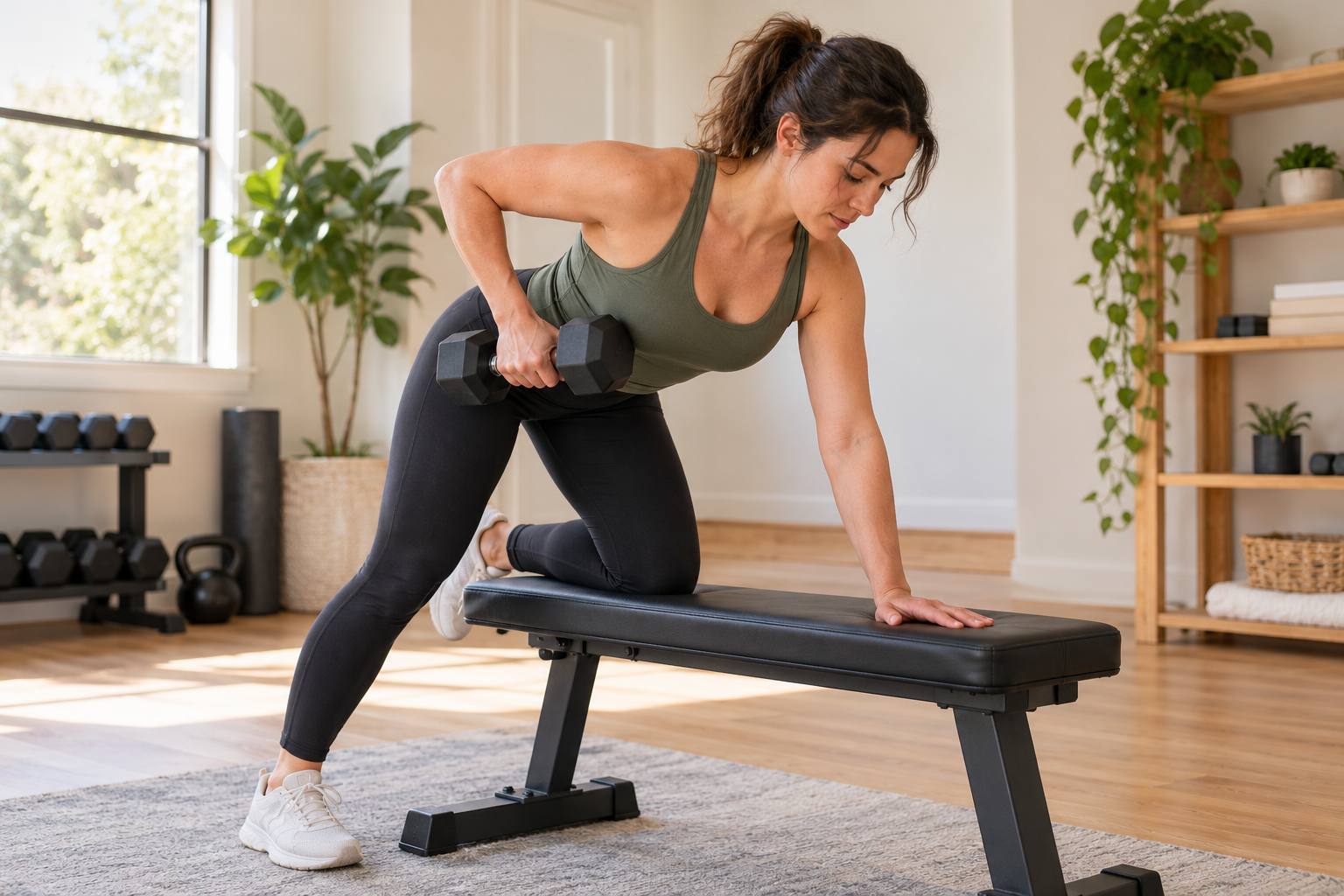
A row means pulling a weight toward your body. Here you work one arm at a time, with your other hand and knee on a support.
How to do it
- Hold a dumbbell in your right hand. Place your left knee and left hand on a bench or sturdy chair. Your hand goes under your shoulder and your knee under your hip.
- Brace your middle. Keep your back flat and your head in line with your spine.
- Let your right arm hang straight down toward the floor.
- Breathe out and pull the dumbbell up toward your side, bending your elbow and keeping your arm close to your body.
- Stop when you can’t lift any higher without twisting your body. Breathe in and lower the dumbbell slowly.
- Finish your set, then switch sides.
Watch for: your body twisting to help lift the weight. Keep your chest facing the floor the whole time.
You should feel: your upper back working.
No dumbbell? Seated band row
Have a resistance band instead of a dumbbell? Row with that. Band training builds strength too.
- Sit on the floor with your legs straight out in front of you.
- Wrap the band around your feet and hold one end in each hand. Sit up straight.
- Pull the band toward your belly, squeezing your shoulder blades together. Stay sitting tall.
- Return slowly.
Bands come in different strengths, so this isn’t automatically easier or harder than the dumbbell version. Choose one you can pull with control. Setting up bands at home is covered in Strength Training at Home.
Carry: farmer’s carry
How to do it
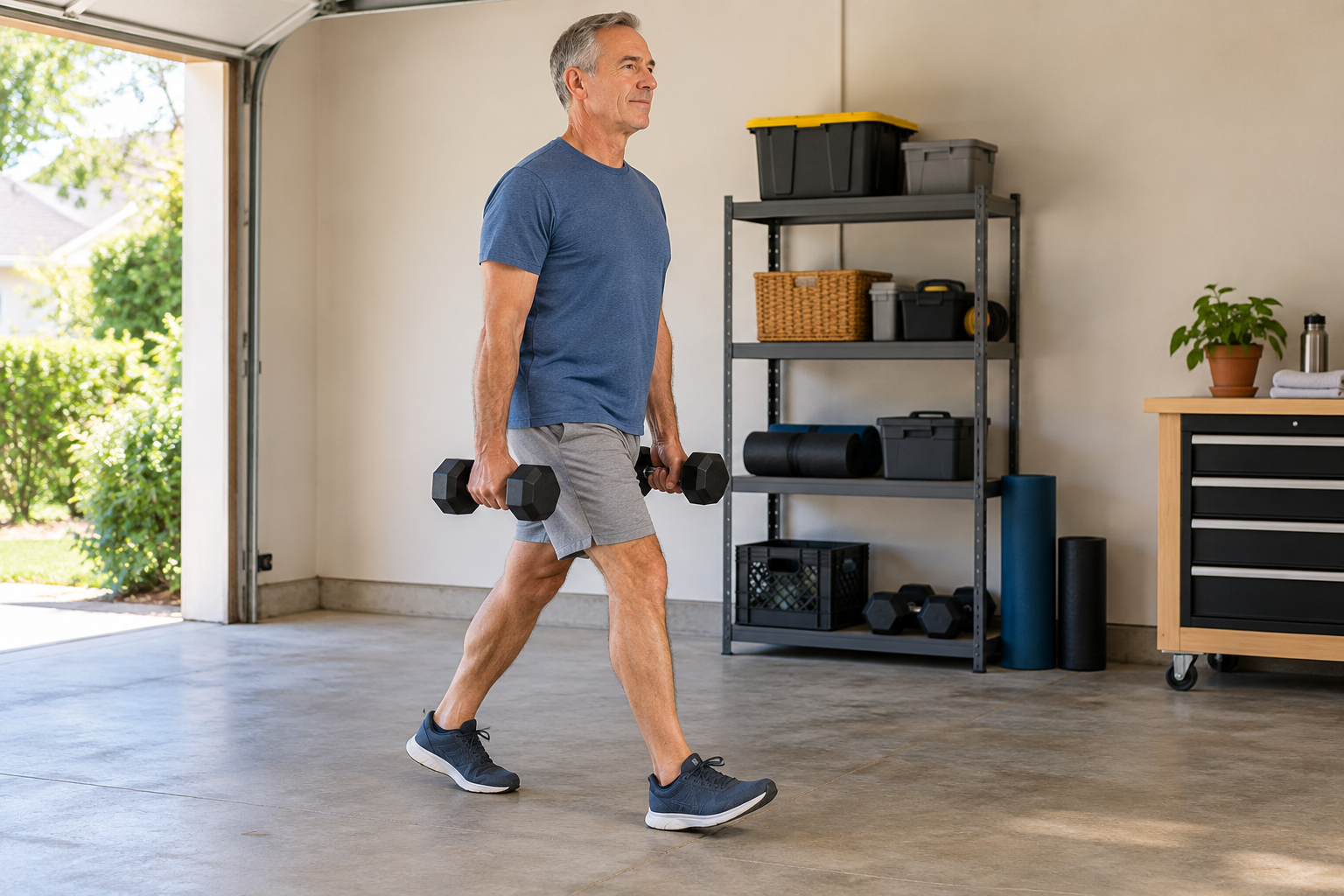
- Hold a dumbbell in each hand with a tight, firm grip.
- Let your arms hang by your sides so the dumbbells sit next to your hips.
- Stand tall with your back straight.
- Walk a set distance you’ve chosen, turn around and walk back.
You should feel: your grip working, and your whole body working to stay tall.
Make it easier
Use lighter weights, or walk a shorter distance.
You don’t always need dumbbells. US guidelines count carrying heavy loads as muscle-strengthening activity when it takes real effort, and the National Institute on Aging gives carrying heavy groceries as an example.
Choosing your five and putting them together
- Pick one exercise from each pattern. Five exercises in total.
- Choose the version you can do with control. The chair rise, unweighted hinge and wall push-up are a real start.
- Use what you have. For building strength, the 2026 ACSM review found free weights and machines worked about equally. A pair of dumbbells and a sturdy bench or chair cover every main exercise above.
How many sets and reps to do, and how long to rest, is covered in Sets, Reps and Rest. For a sample first week built from movements like these, see Strength Training for Beginners.
Common question: do I need weights to start?
No. US guidelines count body-weight exercises such as push-ups, and working with resistance bands, as muscle-strengthening activity. The 2026 ACSM review found that training with elastic bands, and training at home, improved strength compared with doing nothing. (The home-training reviews it drew on studied older adults.) Three patterns here have a no-dumbbell version: the chair rise, the unweighted hinge and the wall push-up. Setting up at home? See Strength Training at Home.
If an exercise causes pain, stop right away. Contact your health care provider about muscle or joint pain that doesn’t go away.
Your task this week: practice all five patterns once, starting with the easiest version of each. Think of it as a trial run to learn the movements, not a full week of training. For every pattern, note which setup you could do with control. That’s your starting point.
Sources
- U.S. Department of Health and Human Services. Physical Activity Guidelines for Americans, 2nd edition. 2018.
- Currier BS, D'Souza AC, Fiatarone Singh MA, Lowisz CV, Rawson ES, Schoenfeld BJ, Smith-Ryan AE, Steen JP, Thomas GA, Triplett NT, Washington TA, Werner TJ, Phillips SM. Medicine & Science in Sports & Exercise 58(4):851–872. American College of Sports Medicine Position Stand. Resistance Training Prescription for Muscle Function, Hypertrophy, and Physical Performance in Healthy Adults: An Overview of Reviews. 2026.
- National Institute on Aging, National Institutes of Health. Exercise and Physical Activity for Older Adults: Staying Active as You Age. 2025.
- National Academy of Sports Medicine (Hamilton H). Strength Training Routines for Beginners: Start Here. updated 2026.
- American Council on Exercise (McCall P), ProSource. Essential Exercises for an Optimal Strength-training Workout. 2014.
- American Council on Exercise. Exercise Library: Bodyweight Squat. accessed 2026.
- American Council on Exercise. Exercise Library: Goblet Squat. accessed 2026.
- American Council on Exercise (McCall P), ProSource. ACE Technique Series: Romanian Deadlift. 2016.
- American Council on Exercise. Exercise Library: Push-Up. accessed 2026.
- American Council on Exercise. Exercise Library: Single Arm Row. accessed 2026.
- American Council on Exercise. Exercise Library: Farmer's Carry. accessed 2026.
- National Academy of Sports Medicine. Exercise Library: Incline Push-Up. accessed 2026.
- Centers for Disease Control and Prevention, National Center for Injury Prevention and Control. Chair Rise Exercise (STEADI). 2017.
- University of Illinois Extension. Wall Push-Ups. accessed 2026.
- University of Illinois Extension. Seated Row. accessed 2026.
- MedlinePlus, U.S. National Library of Medicine. How to avoid exercise injuries. reviewed 2024.
This article is for general information and isn’t a substitute for personal medical advice. If you have health concerns, speak to a qualified professional.