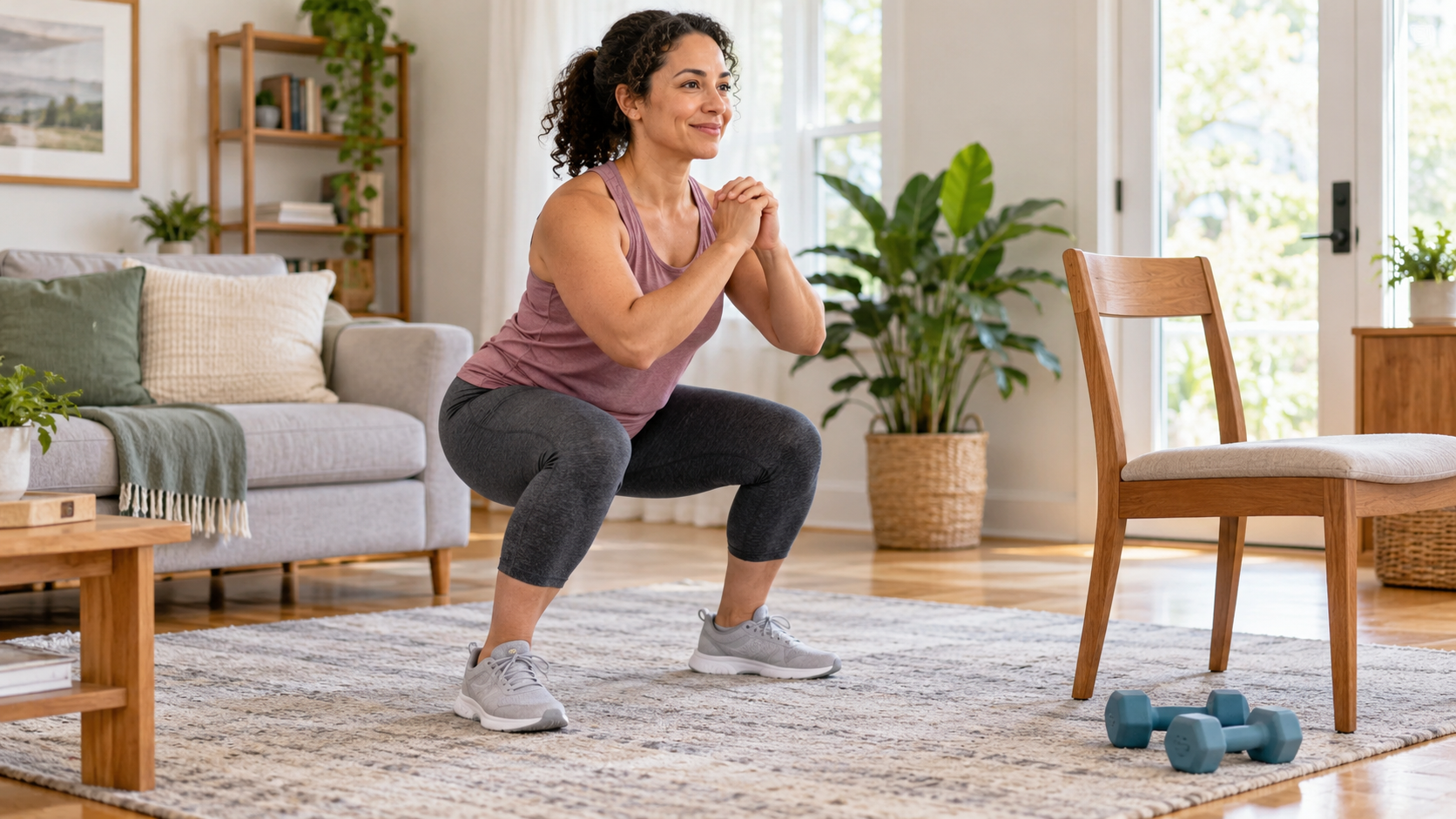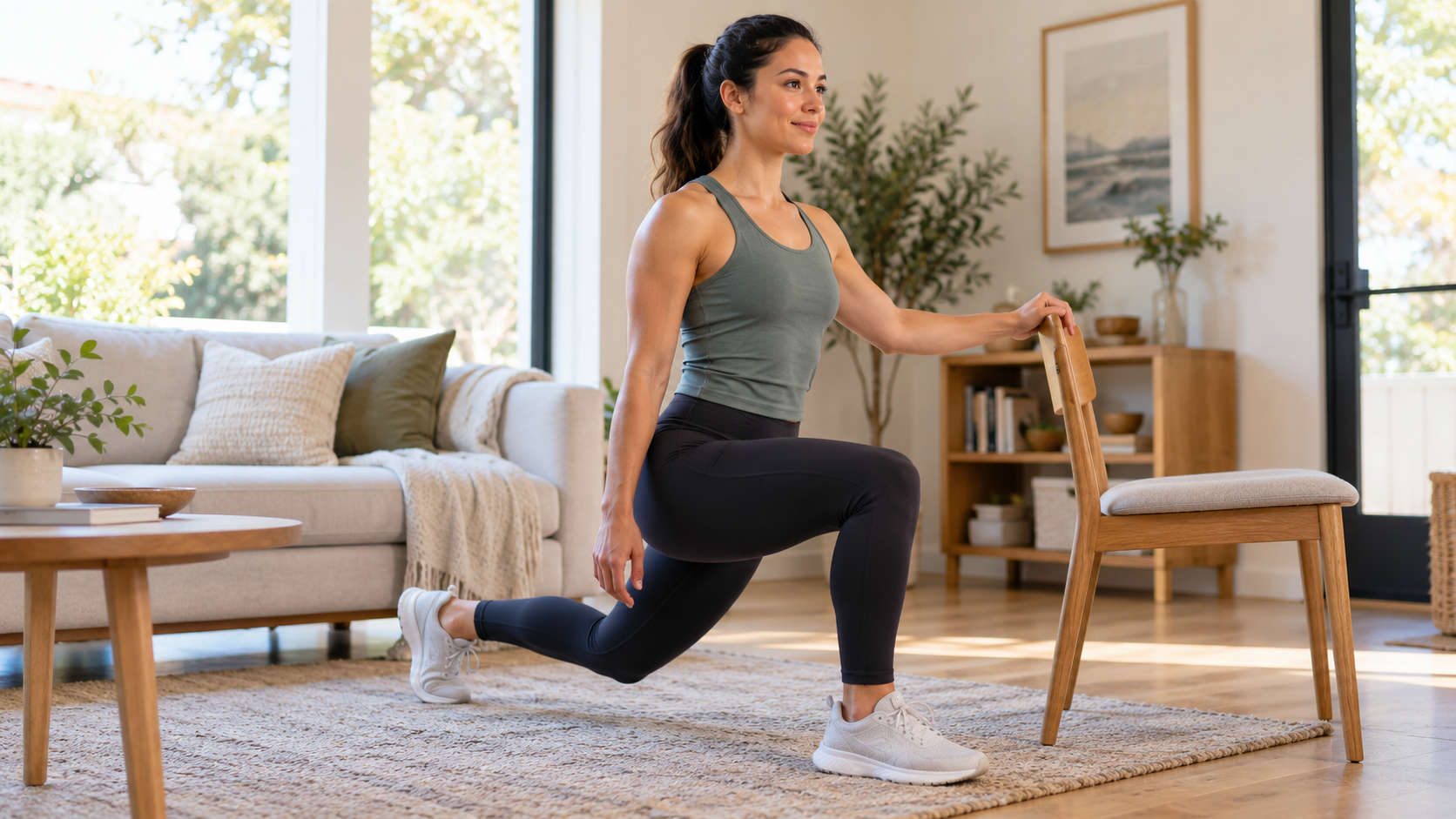
The split squat is a useful first single-leg exercise because the feet stay in place. You can learn the pattern, use a chair for balance and adjust the depth without adding the extra coordination of stepping forward or backward.
It is not a test of how low you can go. It is a way to practise producing force through each leg while keeping the trunk controlled.
Set up before you move
Stand in a comfortable staggered stance, with one foot forward and the other behind. Keep enough distance between the feet that you can lower straight down without feeling folded into a tightrope. Hold a chair or wall if balance is the limiting factor.
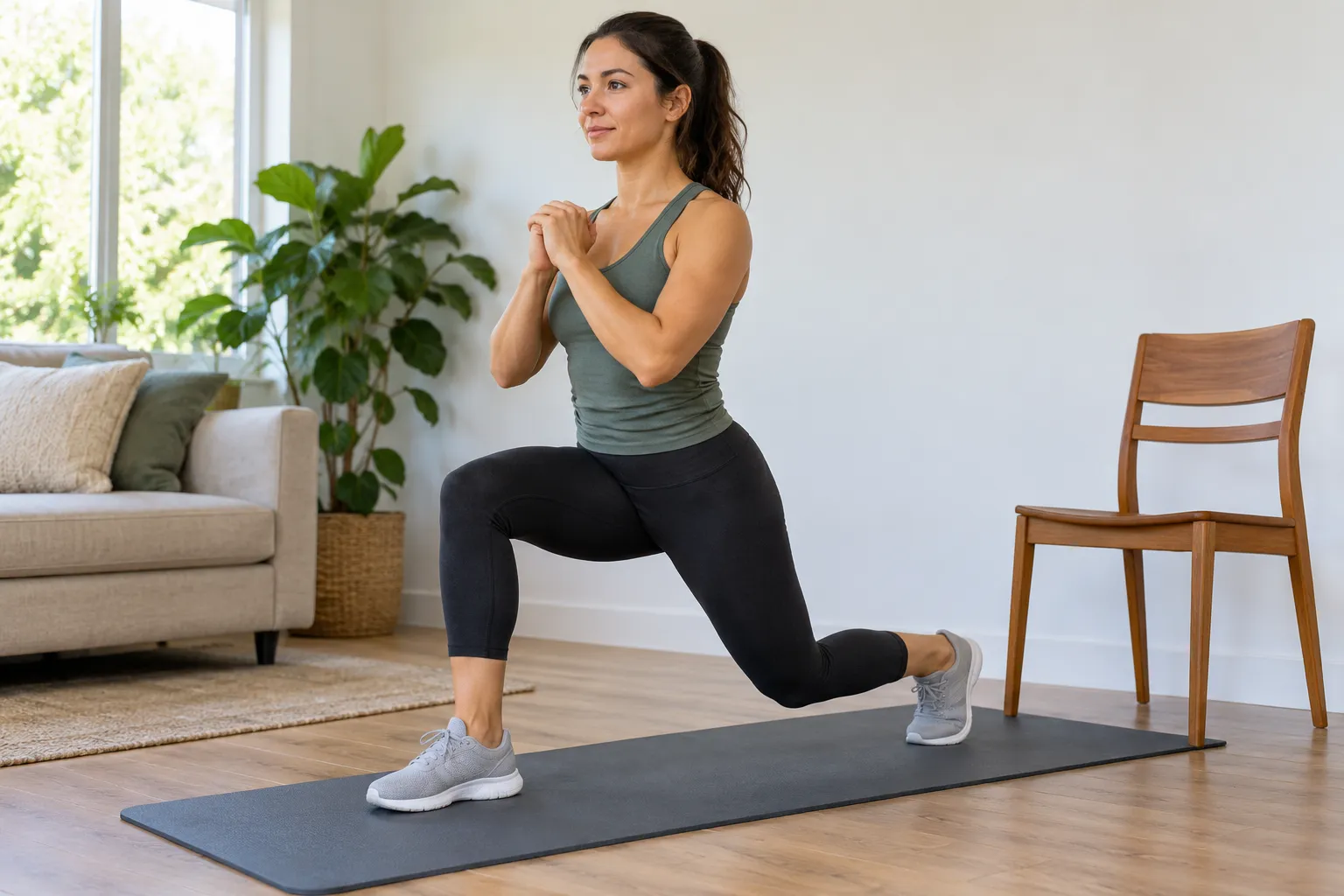
Keep most of your attention on the front foot. The back leg is there for support, not to do all the work. Keep the front foot connected to the floor and let the knee track broadly in the direction of the toes.
Find a comfortable depth
Lower slowly until you reach the deepest position you can control without pain, wobbling or the front heel lifting. You do not need to reach the floor. A shorter range with a steady torso is a valid starting point.
Pause briefly, then press through the front foot to stand. Keep the movement quiet rather than bouncing out of the bottom.
Make it easier
- shorten the range of motion;
- hold a chair with one hand;
- use a wider stance;
- slow down the lowering phase without adding weight;
- practise an isometric hold near the comfortable midpoint.
Support is not cheating. It lets the legs learn the movement instead of making balance the main exercise.
Make it harder
Once bodyweight repetitions are stable on both sides, progress one variable at a time. Add a few repetitions, extend the range slightly, slow the lowering phase, or hold light dumbbells. You do not need to change all four variables at once.
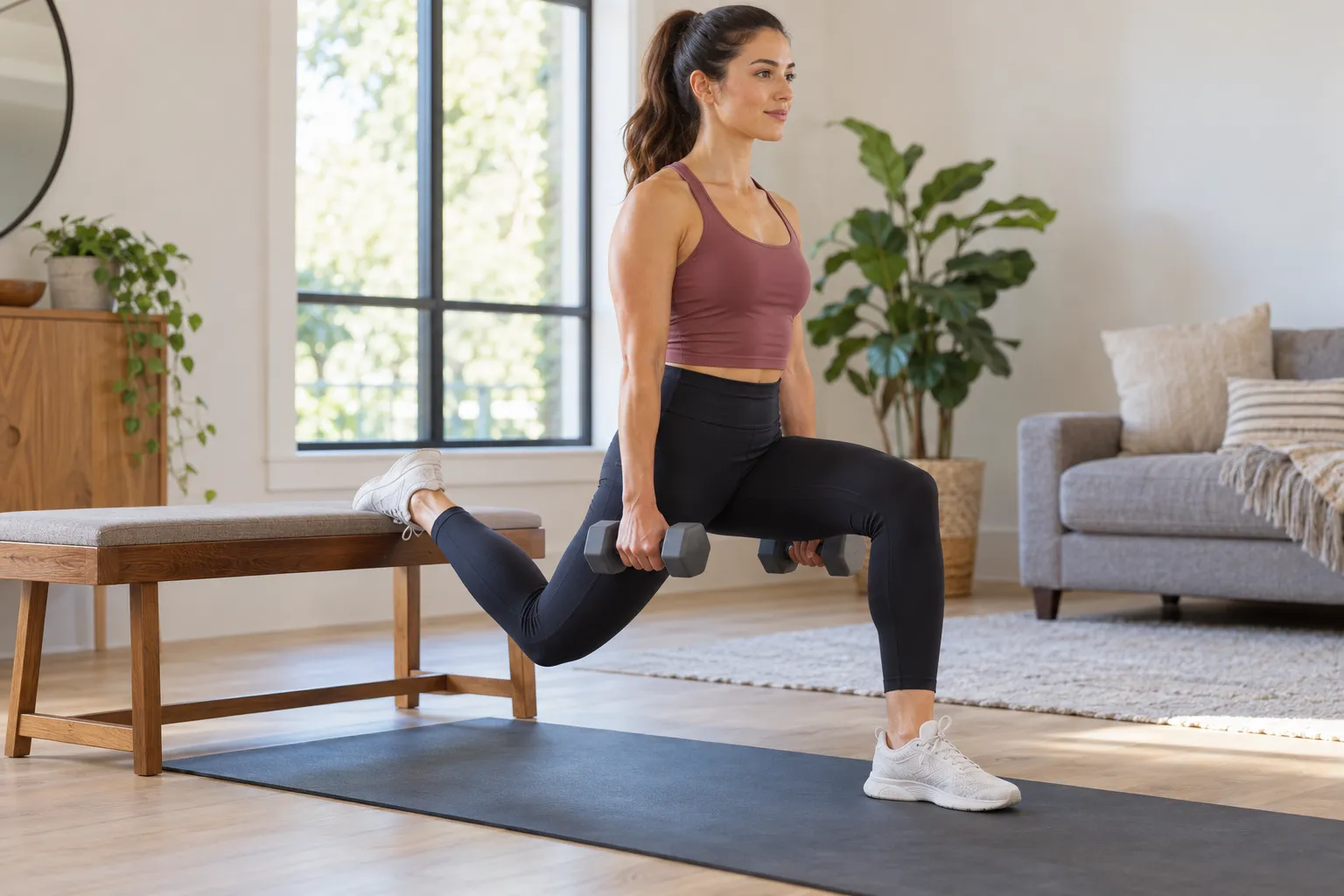
A simple starting dose
Try one or two sets of 6–10 controlled repetitions per side, two or three times a week as part of a broader strength routine. Rest between sides if your balance or breathing starts to deteriorate. The target is repeatable quality, not exhaustion.
Train the less confident side first, then match the same number of good repetitions on the other side. If one side consistently feels painful or unstable, reduce the challenge and consider professional assessment rather than forcing symmetry.
What discomfort means
Muscle effort and mild familiar fatigue are different from sharp pain, swelling, catching or pain that worsens with every repetition. Stop if those symptoms appear. People returning after injury, living with a joint condition or unsure how to modify the movement should ask a qualified professional.
The bottom line
Split squats are valuable because they are adjustable. Use support, shorten the range and stay with bodyweight until the pattern feels controlled. Then progress gradually, train both sides and let technique—not the depth of the lowest repetition—decide when you are ready for more.
Common questions
Is a split squat the same as a lunge?
They are related, but a split squat keeps the feet in place while a lunge includes a step. The stationary setup can make learning and balance easier.
How deep should I go?
Go only as deep as you can control without pain or losing alignment. Depth can increase gradually as mobility, strength and confidence improve.
Which leg goes forward?
Train both sides. You can start with the less confident side and then match the same controlled repetitions on the other side.
Should my front knee go past my toes?
There is no single toe position that suits every body. Let the knee track in the same general direction as the foot while keeping the movement comfortable and controlled.
When should I add weights?
Add light weight only after bodyweight repetitions feel stable on both sides and you can keep the same technique from start to finish.
Sources
- Centers for Disease Control and Prevention. What Counts as Physical Activity for Adults.
- PubMed. Reliability of 1RM Split-Squat Performance.
- PubMed. Female Lower Body Muscle Forces: A Musculoskeletal Modeling Comparison.
This article is for general information and isn’t a substitute for personal medical advice. If you have health concerns, speak to a qualified professional.