
You do not need to become a runner to get fitter. You do not need a special watch, a perfect route, or a punishing plan either.
Walking is a useful place to start. Running can be added later if you want it. The best choice is the one you can repeat often enough for it to become part of your week.
This guide explains how to choose a starting point, judge your effort, build time before speed, and move from walking to short running intervals without turning every session into a test.
Walking, running, or both?
Walking and running are both aerobic activities. The main difference is the intensity and the impact your body has to handle.
Walking may be the better starting point if you are new to exercise, returning after a long break, or looking for a low-barrier routine. A brisk walk can raise your breathing and heart rate while still letting you control the pace.
Running can be useful if you enjoy it and your body tolerates the impact. It is more intense, so the same amount of time can feel harder. That does not make it automatically better. A regular walk three or four times a week is more useful than an ambitious run that leaves you unable to train again for several days.
You can also combine them. A walk-run session gives you a simple way to practise running while keeping the total effort manageable.
What counts as a useful session?
For most adults, the physical activity guidelines use a weekly target of 150 to 300 minutes of moderate-intensity aerobic activity, or 75 to 150 minutes of vigorous-intensity activity, plus muscle-strengthening work on at least two days. That target is a direction, not a pass-or-fail exam.
If you are currently doing very little, start below that amount. Some activity is better than none, and building gradually makes it more likely that you will keep going.
A useful session has three simple parts:
- A few easy minutes to get moving.
- The main walk, run, or walk-run block.
- A few minutes at an easier pace before you finish.
The first and last parts do not need to be complicated. They are simply a chance to ease in and ease out.
Start with time, not speed
Speed is an easy number to chase and a poor first target for many beginners. It changes with hills, weather, sleep, footwear, and your starting fitness.
Use time instead. Decide how long you can realistically set aside, then keep the effort easy enough to repeat.
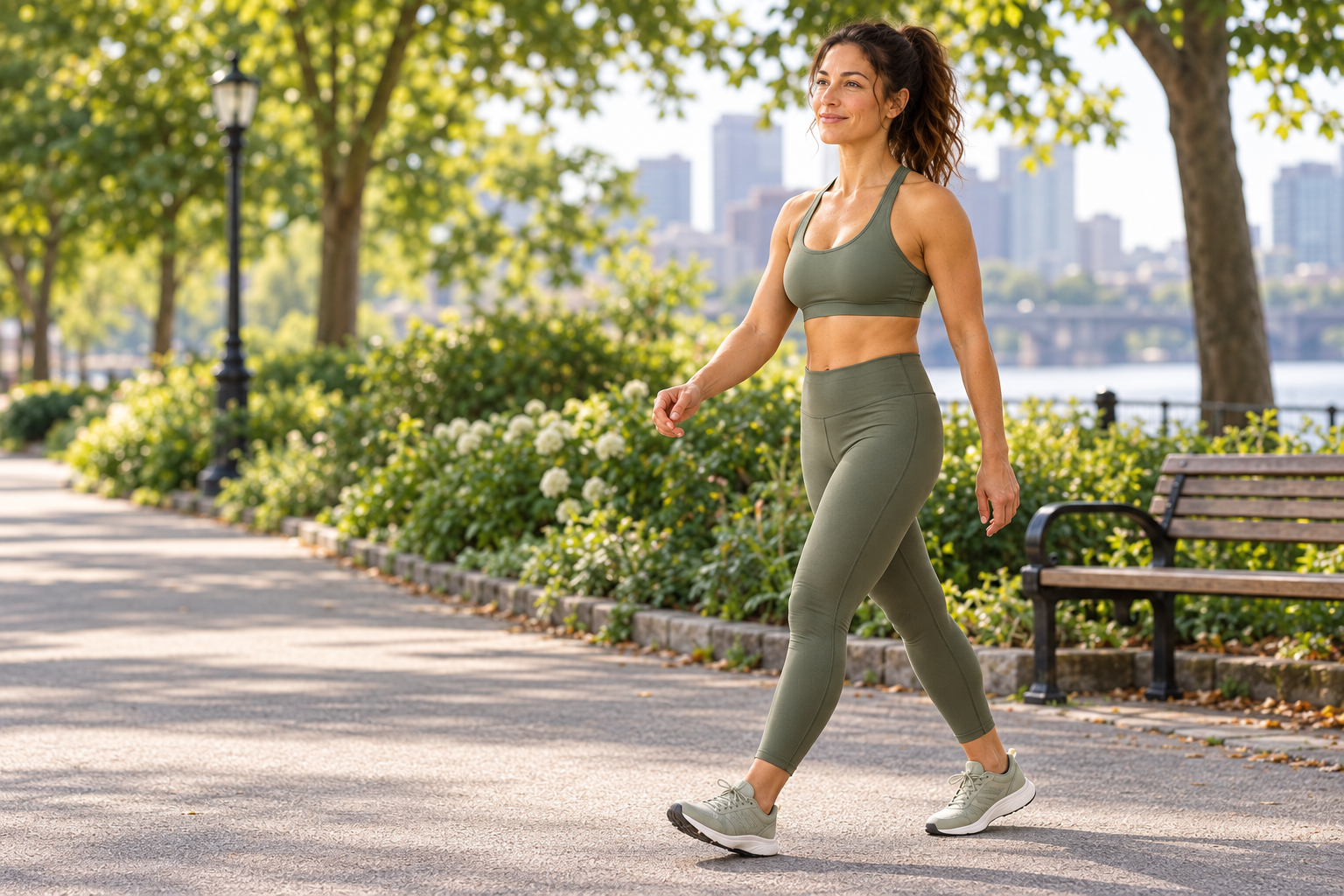
A simple first week might look like this:
- Session 1: 15 to 20 minutes of comfortable walking.
- Session 2: 15 to 20 minutes of comfortable walking.
- Session 3: 20 to 25 minutes of comfortable walking.
Leave a rest day or an easier day between sessions if your body needs it. If this feels too easy, that is fine. Your first job is to create a routine you can continue.
Find an easy pace
The talk test is a practical way to judge moderate effort. At a conversational pace, you can speak in sentences but would not comfortably sing a full song. If you can only get out a few words before stopping for breath, you are working harder.
Do not treat the talk test as a laboratory measurement. It is a simple check that helps you avoid turning every session into a hard session.
For an easy walk, let your breathing settle. For a run, slow down sooner than your pride suggests. A slower pace that keeps you moving is often a better training choice than a fast start followed by a long recovery.
A gentle path from walking to running
You do not have to wait until you can walk a particular distance before trying a short run. You do need to be able to walk comfortably and recover between sessions.
Try this progression only when regular walking feels manageable:
- Walk for 5 minutes to warm up.
- Add 15 to 20 seconds of relaxed running.
- Walk until your breathing settles.
- Repeat the short run once or twice.
- Finish with an easy walk.
Keep the running intervals short at first. The aim is to practise the movement, not to prove how long you can hold it. Over several sessions, add a little time to one interval or add one extra interval. Change one thing at a time.
If running makes your joints hurt, changes your stride, or leaves you unusually sore, go back to walking and reassess. Pain is not a progress marker.
Choose a route you will actually use
The best route is not necessarily the most scenic one. Look for a route that feels safe, is convenient, and matches your current ability.
Flat pavement can make pacing easier. A gentle trail may make the session more enjoyable but can add uneven ground. A treadmill gives you control over weather and surface, while removing some of the variety of outdoor walking or running.

Start on a surface that lets you pay attention to your movement. Save steep hills, technical trails, or long uninterrupted runs for later, if they fit your goals.
Wear shoes that feel comfortable and secure. You do not need the most expensive pair. If footwear causes rubbing, numbness, or pain, change it rather than trying to push through.
How often should you go?
Consistency matters more than a perfect weekly pattern. Two or three sessions can be enough to establish a routine. If you enjoy daily walking, easy walks can be spread across the week; a run-walk session may need more recovery around it.
A simple week can include one longer easy walk, one shorter walk or walk-run session, and one optional easy session if you feel recovered. Add strength training on separate or suitable days when you can. Strength work is its own part of a balanced activity plan.
What to do when motivation drops
Motivation is unreliable. Reduce the number of decisions you need to make. Choose two or three recurring time slots, keep comfortable clothes ready, and use the same short route for some sessions.
Have a minimum version for difficult days: ten easy minutes outside or on a treadmill. If you feel better after ten minutes, continue. If not, finishing the minimum still protects the habit.
Do not turn one missed session into a verdict about your fitness. Resume at the last level that felt manageable.
When to hold steady or reduce the plan
Stay at the same duration when the session still feels unfamiliar, your recovery is poor, or your form changes as you tire. You do not need to progress every week.
Reduce the time, slow down, or take an extra rest day if soreness is increasing from session to session. MedlinePlus advises easing back when you have signs of overtraining such as unusual fatigue, heavy limbs, persistent soreness, or a drop in performance.
Stop exercise and seek appropriate medical advice for symptoms such as chest pain, fainting, severe shortness of breath, or pain that does not settle. If you have a health condition, are pregnant, or are returning after an injury, ask a qualified clinician how to adapt activity for you.

A flexible four-week framework
This is a flexible framework, not a prescription.
Week 1: two or three easy walks of 15 to 25 minutes.
Week 2: two easy walks plus one slightly longer walk, adding only a few minutes if Week 1 felt comfortable.
Week 3: two walks and one session with one or two very short run intervals, if walking feels good.
Week 4: repeat Week 3 or add one small change: a little more time, one extra interval, or a gentle hill. Do not add all three at once.
The framework works because it leaves room to repeat a week. Repeating is not falling behind; it is how you make the next step feel ordinary.
The takeaway
Start with the activity you can repeat. Use time and conversation as your first measures. Build walking before you chase speed, and introduce running in short, relaxed intervals when regular walking feels manageable.
The goal is not to finish the hardest session you can survive. It is to create a pattern of movement that fits your life and leaves you ready to do it again.
Sources
- U.S. Department of Health and Human Services. Physical Activity Guidelines for Americans. current edition.
- National Institute on Aging, National Institutes of Health. Four Types of Exercise Can Improve Your Health and Physical Ability. reviewed 2025.
- MedlinePlus, U.S. National Library of Medicine. Overtraining syndrome. reviewed 2024.
This article is for general information and isn’t a substitute for personal medical advice. If you have health concerns, speak to a qualified professional.